Marot's table prayers, set to music
O souverain pasteur et maistre (Table blessing -
before dinner, Grace)
&
Pere Éternel qui nous ordonnes (Table grace - after
dinner, Thanksgiving)
Marot's two 'prandial prayers' (click here for the texts)
belong to the favorites of composers, esp. among 'Flemish'
composers (6 in the list below). They always make who set both
texts. NB: only he early Psalters contain a melody (Geneva:
the last with melody is 1551). Many of the entries in chanson
database
Ricercar (University of Tours), and in Howard Slenk,
The Huguenot Psalter in the Low Countries (Ohio, 1965,
unpublished diss., p. 194). They also are a stable element of
the famous 'livre septiesme' (1567 onwards).
Benediction: O souverain pasteur et maistre
Grace: Pere Éternel qui nous ordonnes
-
à 4: Antoine Mornable, Livre second
contenant XVII pseaulmes...(Paris: Attaingnant,
1546)
-
à 4: Tielman
Susato, Unziesme livre contenant vingt et neuf
chansons amoureuses et deux prières
(Antwerp: Susato,1549) - music publisher and
composer in Antwerp [listen to his version of the
'thanksgiving after the meal': 'Père Éternel qui nous
ordonnes" (ensemble Clément Janequin)
-
-
à 4: Le Gendre, Premier livre de
psalmes et cantiques en vulgaire franoys (Paris:
Fezandat, 1552)
-
à 4: Guillaume
La Moeulle, Premier livre des
pseaumes... G.Guéroult & autres... la
plupart par G. de la Moeulle (Genève:
Dubosc/Gueroult, 1554)
-
à 4: Loys Bourgeois, Pseaulmes
LXXXIII de David, Le cantique &c. (Lyon:
Godefroy Beringen, 1554)
-
à 4: Jacob
Clement (Clemens non Papa, d. 1555) [first:
Phalèse 1564 (Vanhulst 107)], Septiesme livre des
chansons a quatre parties, (Louvain, P. Phalèse,
1567); The septiesme livre,
that ismany reprints everywhere until 1644 and even
occasionally afterwards.
-
à 4: Pierre Certon, Cinquante
Pseaumes de David (Paris: Le Roy/Ballard, 1555)
-
à 4: Barthélémy Le Bel, Le second
livre des Pseaulmes et sentences tirees tant du
psalmiste royal que des autres saincts prophetes: mis
en musique en forme de motetz, par divers excellens
musiciens.(Genève: Dubosc/Guéroult, 1555) Contains
works by Arcadelt, Gindron, Goudimel, and Le Bel.
-
à 4: Ph. Jambe-de-Fer, Psalmodie de
quarante et un pseaumes royaux... (Lyon: Michel
Dubois, 1559)
-
à 5: Derick
Gerard(e) [Manuscript: British Library, Royal
Appendix 31-35]
-
à 4: Martin
Peudargent, Novi prorsus et elegantis libri
musici, in quo continentur partim suavissima ...
Moteta ... latinae & gallicae 4, 5,
6-stemmige motetten (Düsseldorf: Oridryus & Buysius,
1561). Unique copy lost in the war (?)
-
à 4: Claude Goudimel, Pseaumes de
David.. (Paris: Le Roy/Ballard, 1562)
-
à 3: Geert
van Turnhout (or Gerardo à Turnhout): Sacrarum
ac aliarum cantionum trium vocum, (Louvain, P.
Phalèse, 1569)
-
à 5: Andries
Pevernage, chansons d’Andre Pevernage livre I,
chansons spirituelles (Antwerp, Plantin, Plantin,
1589) P1670
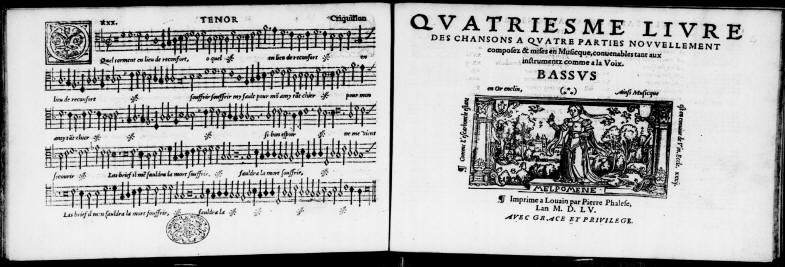
By the way: the two earlier prandial prayers were
set to music by Jean Crispel (published by Phalèse, Louvain,
in 1552: Quatriesme livre des chansons a quatre
parties..., repr. 1555): The 4 partbooks for these two
songs I have collated on one page (digital copy made available
by the British Library: K.3.a.15). "Le
benedicite" and "La grace"
as they are labelled. Together with a modern transcription
(SATB)
biographical info excerpted from
Jacob Clement (non Papa)
b ?? d1556 ?
Clemens first appears in the historical record with the
publication of several chansons by Attaingnant in Paris
beginning in the late 1530s. The sobriquet 'non Papa' is first
recorded in 1542, the date of the attribution of Je prens
en gre (previously printed anonymously) in a set of
manuscript partbooks belonging to the Flemish merchant Zeghere
de Male. In 1545 Clemens established a business relationship
with the Antwerp printer Susato, one of his chief publishers.
In Susato's Souterliedekens of 1556'7 the composer is called
'Jacobus Clement non papa', thus connecting his usual
designation with what was clearly his original name, Jacob
Clement.
Clemens was succentor at Bruges Cathedral from March 1544
until June 1545. The chapter acts of the cathedral for 12
March 1544 mention 'Jacobus Clement Pbro' (presbyter), and on
26 March Clemens was nominated succentor 'per modum probae';
the fact that he had to pass a proficiency examination
indicates that he was hardly known. He honoured the
cathedral's patron with his Missa 'Gaude lux Donatiane'. It is
possible that he was subsequently appointed choirmaster to
Philippe de Croy, Duke of Aerschot, one of Charles V's
greatest generals. Three state motets, Carole, magnus
eras, Caesar habet naves validas and Quis te
victorem dicat, point to a relation with Charles V from
1544 to 1549. Clemens was employed as sanger ende
componist by the Marian Brotherhood in 's-Hertogenbosch
from 1 October to 24 December 1550. The motet 'ter eeren onser
liever vrouwen', which he offered to the brotherhood on his
departure, is no doubt his seven-voice Ego flos campi on a
text from the Song of Songs. The words 'sicut lilium inter
spinas', which are given prominent homophonic treatment, were
the brotherhood's motto, and the use of seven voices (unique
in Clemens's work) embodies the symbolic Marian number seven.
Some connection with Leiden is apparent, for all six
choirbooks of the St Pieterskerk (Municipal Archives) dating
from the mid-16th century contain works by Clemens: two masses
(including the Missa 'Or combien' with an ascription to
Crecquillon), a cycle of eight Magnificat settings and 34
motets; for one of the motets and the Magnificat cycle these
choirbooks are a unique source. It is almost certain, however,
that he was not choirmaster of the St Pieterskerk, and he may
never have been resident in Leiden. The year of Clemens's
death has been a subject of controversy. There are several
reasons for supposing that he died in 1555 or 1556. Although
he is still listed as a living composer in Hermann Finck's
Practica musica (1556), a manuscript copied in Antwerp in
1564/6 (B-LVu mus.4), contains his motet Hic est vere
martyr with the annotation, 'Ultimum opus Clementis
non Papae anno 1555 21 aprilis'. Ten of the
souterliedekens printed in 1556'7 in volumes devoted to him
are actually by Susato. In 1556 the first of Clemens's masses
was published with a dedication written by the publisher,
Phalèse. In 1558 Jacobus Vaet published in Nuremberg his
déploration on Clemens's death, Continuo lacrimas, whose text
suggests he met a violent end ('inclemens vis et violentia
fati'). According to Sanderus (Flandria subalterna, ii,
Cologne, 1644) Clemens was buried at Dixmuiden, near Ypres.
Martin Peudargent
(b Huy, c1525/30; d after 1587). Flemish composer. He was for
much of his career in the service of the Duke of Kleve as
Kapellmeister. In his first work, published in 1555, he
referred to himself as 'musicus' in the court of Duke Wilhelm
V of Jülich-Kleve-Berg in Düsseldorf. Oridryus, in his
treatise Practicae musicae (Düsseldorf, 1557), referred to him
in friendly terms and described him as praefectum in the
duke's chapel. Peudargent is known to have been present at
J'lich in 1585 for the marriage of Duke Johann-Wilhelm and the
Margravine Jakobe von Baden, and he was named by Gramin'us as
the principal musician there. It is clear that he remained for
more than 30 years in the service of the Duke of Kleve; by
1587, when he petitioned his master for assistance, he had
become blind and was no longer able to support his family.
Andries Pevernage
(b Harelbeke, nr Kortrijk, 1542/3; d Antwerp, 30 July 1591).
Flemish composer. On 21 January 1563 he was appointed
choirmaster of St Salvator, Bruges, and on 22 September of the
same year he was named to a similar post at Onze Lieve
Vrouwkerk, Kortrijk. He remained in Kortrijk until 1577
although he held a prebend at St Willibrordus in Hulst in
1564. In 1578 Kortrijk fell briefly to Calvinist rule. By the
following year Pevernage had secured the position of
choirmaster at St Jacob, Bruges. This city too fell to the
Calvinists and Catholic services were suppressed there from
May 1581 until 1584. On 1 October 1584 he was reappointed to
his former position at Kortrijk and less than a year later
became choirmaster at Antwerp Cathedral where he remained
until his death. He was buried by the cathedral's altar of St
Anne. Antwerp archives confirm that Pevernage rebuilt the
music library destroyed by the Calvinist rebellion and that he
was active in humanist circles surrounding the Plantin press.
Tielman Susato
(b c1510'1515, Soest, nr Dortmund; d ?Sweden, 1570 or
later). Music publisher, composer and instrumentalist, active
in the southern Netherlands. Some confusion has been caused by
Susato's reference to Dutch as 'our mother tongue' in his
first book of Dutch songs (1551); however, this is logical
considering his residence of more than 20 years in Antwerp and
the audience to whom the print is addressed.In 1541 Susato
formed a partnership with two Antwerp printers, Hendrik ter
Bruggen and Willem van Vissenaken; he probably served as the
compiler for Antwerp's first single-impression music book,
Quatuor vocum musicae modulationes, issued in 1542 under
Vissenaken's name. Following a long and complex lawsuit,
Susato acquired all shares in the business and set up a
printing house on Twaalfmaandenstraat, moving to a newly built
house called the 'Cromhorn' in 1551. Between 1543 and 1561 he
published 22 chanson books (in two series), 3 books of masses,
19 motet books (in two series) and 11 books in a series
entitled Musyck Boexken including two books of secular Dutch
songs, one book of dances arranged from popular songs, and
eight books of souterliedekens (psalm settings). A number of
these publications were reissued in later 'hidden' editions
bearing the same date as the first.
Most of Susato's publications are anthologies of works by
Flemish composers active in the Low Countries and at the
Imperial Court; the chanson and motet books were published in
series organized by mode and voicing. Among those issued in
single-composer editions were Susato himself as well as Thomas
Crecquillon, Orlande de Lassus, Clemens non Papa and Josquin
Des Prez. Josquin's Septiesme livre des chansons (1545),
issued 24 years after the death of the composer, is the
earliest published source for 23 chansons; this has raised
questions concerning Susato's source for the works and the
accuracy of his attributions. Susato published Lassus's
so-called 'op.1', a collection of chansons, madrigals,
villanesche and motets, as an added book in his first chanson
series (Le quatoirsiesme livre, 1555), and he later issued a
motet book by Lassus as well. His eight books of Dutch-texted
metrical psalm settings (Souterliedekens)- four each by
Clemens non Papa and his student Gherardus Mes - were intended
for home devotional use.
As a composer Susato wrote over 90 chansons, many of which
parody well-known French and Flemish models. Two books (1544
and 1552) contain two- or three-part didactic settings, and
other larger-voiced settings are expanded parodies in
imitative style of famous chansons. Many of Susato's chansons
are arranged in groups of textually and musically related
works called responses and replicques while his dance
collection (1551) features simple four-voice arrangements of
well-known chansons set in homophonic style, probably intended
for amateur performance. His motets are well-crafted in
imitative polyphony; In illo tempore (1545) is the basis for
his only mass, and Salve quae roseo decora (1540) is an
occasional work in praise of the city of Antwerp.
Geert van Turnhout
(b Turnhout, c1520; d Madrid, 15 Sept 1580). Flemish
composer, active in Spain, elder brother of the composer Jan
van Turnhout. The family name was originally 'Jacques', as
Spiessens has shown. In his early career he held positions at
the church of Our Lady, Antwerp, and at the church of St
Gummarus, Lier, where he became ma'tre de chapelle in 1559. He
entered holy orders, though no date for his ordination is
established. In 1562 Turnhout became music master of the
Confraternity of Our Lady at the church of Our Lady, and
ma'tre de chant there in 1563. In 1564 he composed a Te Deum
for the entry into Antwerp of Margaret of Austria, Regent of
the Low Countries. Looting by iconoclasts destroyed the music
collection and organs at the cathedral in 1566, and in the
following years Turnhout copied out masses, motets etc., to
replace what had been lost. He also presided over the
commission which examined the new organs constructed by Gillis
Brebos.
Through the Duke of Alva as intermediary, Philip II of Spain
engaged Turnhout on 2 May 1571 as maestro de capilla of the
Capilla Flamenca in Madrid. After a delay of over a year
Turnhout travelled to Madrid, bringing with him, as was
customary, a group of singers from the Low Countries. His name
is first noted as maestro de capilla in November 1572. There
is little record of Turnhout's activities during his eight
years in Spain. He was held in high esteem by Philip II, as is
shown by the many prebends granted to him.
Gerarde Derrick (fl
c1540'80). Flemish composer, active in England. Nothing is
known about his origins, musical upbringing or career outside
England. During the third quarter of the 16th century he was
associated with Henry Fitzalan, 12th Earl of Arundel (d 1580),
and Arundel's son-in-law and heir John, Lord Lumley (d 1609).
Details of the connection are lacking; it is unclear whether
music was Gerarde's main interest or occupation, and claims
that he served as Arundel's composer-in-residence or
choirmaster are unproven. Evidence of Gerarde's residence in
England can be gleaned from six sets of manuscript partbooks,
most of which are devoted exclusively to his own compositions.
All six sets, which can be placed in chronological order on
grounds of handwriting and notation, were owned either by
Arundel or Lumley, and in 1596 formed part of the celebrated
library at Nonsuch Palace. Four of them survive intact (GB-Lbl
Roy.App.17-22, 26-30, 31-5 and 49-54), the others are
incomplete (Lbl Roy.App.23-5 and 57). No trace remains of a
manuscript described in the 1596 Nonsuch inventory as -A rolle
of Cannons of Dethick Gerrarde-.
Approximately 170 compositions by Gerarde survive, scored for
between four and ten voices. With the exception of the
tentatively attributed instrumental pieces in Lbl
Roy.App.74-6, all are vocal, the majority of them with Latin
or French words. There are no masses or Magnificat settings,
and few motet texts derive from the Roman Catholic liturgy.
Gerarde's early works favour continuously imitative polyphony;
pieces found only in his later partbook sets often make
greater use of homophonic textures and less rigorously
imitative techniques. Gerarde also composed several Italian
madrigals, two English-texted pieces (one of which, Lorde be
my Judge, is a metrical psalm setting), and one work,
Pandalidon, in an apparently invented language. No collected
edition of Gerarde's music has yet been attempted.
|
